


Life Transitions and Self-Trust: Why Change Isn’t a Problem to Fix

Walking is one of my favourite things to do.
Sometimes I walk alone. Sometimes with my husband. Sometimes with friends. Less often now — but still treasured — with my daughter.
Each version offers something different.
When I walk by myself, something settles. My body starts moving and, without forcing it, my mind begins to process. Things that have been swirling — half-formed thoughts, decisions I’ve been avoiding, emotions I haven’t quite named — start to untangle. I don’t think my way to resolution. It just arrives.
When I walk with my husband, it’s a way to connect. We talk about the ups and downs of life, work, family, the big stuff and the ordinary stuff. Sometimes we don’t talk at all. Companionable silence has its own kind of intimacy.
When I walk with my daughter — which happens less and less now as she grows into her own world — it’s simply time together. No agenda. Just presence.
And when I walk with friends, I’m reminded that it isn’t just me. Whatever I’m navigating, whatever feels heavy or confusing, someone else is too. That alone is regulating.
Walking, for me, is where awareness happens naturally.
And awareness, I’ve learned, is where every meaningful transition begins.
Life transitions aren’t the problem — resistance is
I have a deep dislike for the phrase “as I get older…”
You know the one. It’s usually followed by a list of things you supposedly can’t do anymore. Your body has changed. Your fitness has declined. Your drive has faded. Your value has somehow diminished.
Absolutely not.
Have things changed for me? Yes.
Have I had to make adjustments? Also yes.
But those adjustments haven’t meant shrinking, softening into irrelevance, or losing my edge. They’ve meant paying closer attention.
That’s what most life transitions actually ask of us — not surrender, but awareness.
When well-meaning advice doesn’t quite fit
Last year, more than one professional told me I needed to reduce stress.
Slow down. Reduce load. Be less intense. Rest more. Do less.
And look — to a certain extent, I agreed.
I did need more recovery. I did need mobility. I did need to stop training like I was indestructible.
So I dialed things back. I took longer breaks. I softened the edges.
And honestly?
I hated it.
Not because recovery and mobility aren’t valuable — they’ve been essential, and I’ll continue them daily — but because something vital was missing.
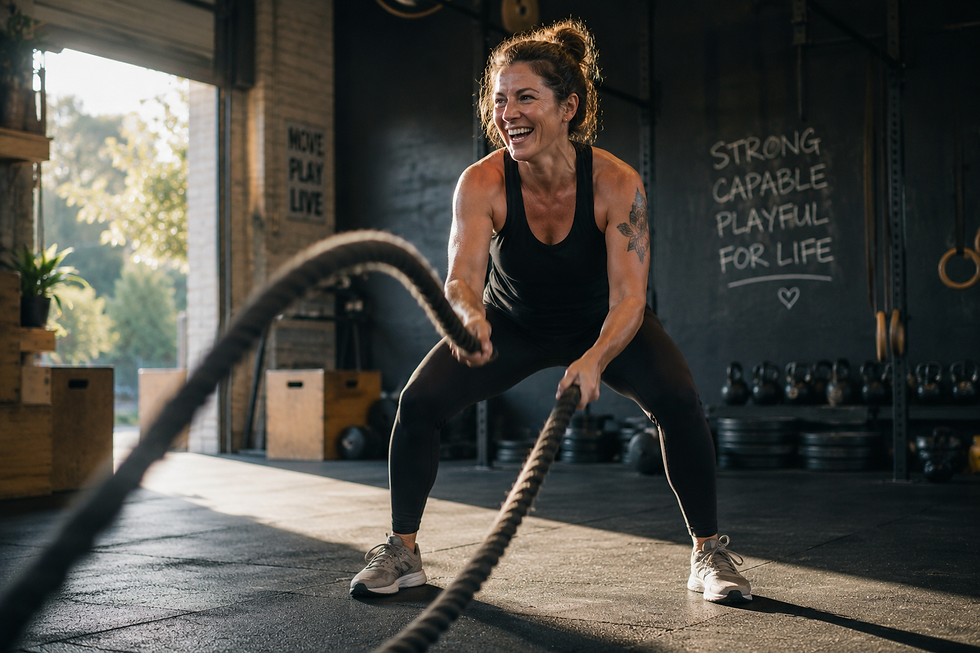
I like to go hard. I like to lift heavy. I like to push until my body is shaking and see what’s still there.
That isn’t ego for me. It’s regulation.
The moment something clicked
Earlier this year, I came across some information about myself — twice, from two different people, on the same day.
And it landed.
Hard.
I need to burn off adrenaline. Not metaphorically. Biologically.
That’s why I’ve always trained the way I have. That’s why stillness-only approaches never quite worked for me. That’s why intensity, when applied intelligently, makes me calmer rather than more wired.
When I heard this, my whole body went:
YES. This. Finally.
It wasn’t permission to ignore recovery. It wasn’t a return to punishment training.
It was permission to trust what I already knew about myself.
And I was instantly happier.
Self-trust isn’t stubbornness — it’s discernment
This experience reinforced something I see every week in my work:
You usually know yourself better than anyone else. But sometimes, you need context. Language. A framework that makes sense of what you’re feeling.
That’s not weakness. That’s learning.
Over the past year (and more), I’ve deliberately turned toward understanding why I do what I do. Why I’m drawn to certain environments. Why certain responses live in my body. Why some things light me up while others drain me.
It’s been eye-opening. Exposing. Vulnerable.
I didn’t love everything I saw.
The mirror was uncomfortable at times.
But it was worth it.
Because awareness without honesty is just intellectual entertainment.
Awareness is only the beginning
This year, something shifted.
I’m no longer just gathering insight — I’m implementing it.
And without implementation, knowledge is worth nothing.
Already, I’ve noticed changes:
I’m less reactive to people in my space
I catastrophise less
There’s less fear humming under the surface
At the same time, awareness has sharpened.
I notice what’s still there. And what I didn’t know was there.
Reluctance to trust people enough to let them in. Fear of rejection. Genuine surprise when people show up when they say they will.
These aren’t things to “fix”, they’re things to work with.
And I’m not putting them on a timeline or a personal development checklist. I’m meeting them as they arise.
That’s capacity building in real time.
The quiet grief of seeing yourself clearly
This month, I also realised how much my husband has had to manage me over the years.
Twenty-seven years, to be exact.
My anger when someone invades my space. My frustration spilling out constantly. How easily I’ve let that frustration spoil an entire night instead of moving on.
That realisation made me sad. Not shame-sad. Grief-sad.
Because awareness doesn’t just bring freedom — sometimes it brings mourning for the impact we didn’t fully see before.
But here’s the thing:
I don’t collapse under that awareness anymore. I don’t armor up against it. I don’t justify it.
I stay with it.
That’s what real transition looks like.
Transition isn’t about becoming someone else
Life transitions don’t ask you to abandon who you are.
They ask you to become more honest about who you’ve always been.
To train in a way that supports your nervous system, not fights it. To move in ways that discharge stress instead of storing it. To lead yourself — and your family — with awareness rather than reaction.
This is the work we do inside Street Smart every week.
Not to create tougher people. But steadier ones.
People who trust their instincts. Who adapt without losing themselves. Who become the calm reference point others feel safe around.
Including their kids.
A question to carry with you
As you move through your own transitions, consider this:
Where are you forcing change — and where is your body quietly asking for a different approach?
You don’t need to solve it today. You just need to notice.
Awareness always comes first.


Love this! I feel similarly. Sometimes 'common wisdom' on a topic simply isn't suitable for us.