


Embodied Confidence: When Skills Become Instinct

On Fear, Accountability, and What Actually Changes When You Keep Showing Up
When most people find Breaking Barriers, they're looking for something specific.
Fitness. Strength. Confidence. Maybe a friend told them how much fun we have while we're working hard — and they were curious enough to try. On the more serious side, some find me because they need something different. A coaching approach that understands trauma, that recognises the patterns that have made movement — and change — feel impossible before now.
What they're looking for, and what they actually find, are often two different things.
Because what happens here — if you stay long enough and choose to look — is not just a narrative of physical fitness. It's a narrative of your life. What you do with your body and your mindset on the mats has a direct and measurable impact on how you show up in the parts of your life that matter most. Your relationships. Your family. The way you respond under pressure. The way you treat yourself when you fall short.
That is — if you choose to be accountable for it.
That might sound harsh. I don't entirely mean it to be. But I'm coming at this, as always, from my own experience. And that's the only honest place I know how to come from.
What Fear Actually Does
Last month we talked about capacity — about the difference between making excuses and being genuinely outside what your system can currently hold. About the honest conversation that has to happen before real change can begin.
Fear operates in exactly the same territory. It sits right at the edge of capacity and tells you that edge is a wall.
It isn't. But it feels like one. And the longer you've been responding to that feeling as though it's a wall, the more your nervous system has learned to treat it as fact.
This is the thing about fear that doesn't get talked about enough in fitness spaces: it's not a mindset problem. It's a body problem. Fear lives in the nervous system. It's a conditioned response — built over years of experience, reinforced by repetition, kept alive because at some point it served a purpose. It kept you safe. It kept things manageable. It helped you survive a chapter that needed surviving.
The difficulty is that the nervous system doesn't automatically update when the chapter ends. The response that made sense then keeps firing now — in situations where it's no longer useful, in relationships where it creates distance, in business decisions where it keeps you smaller than you actually are.
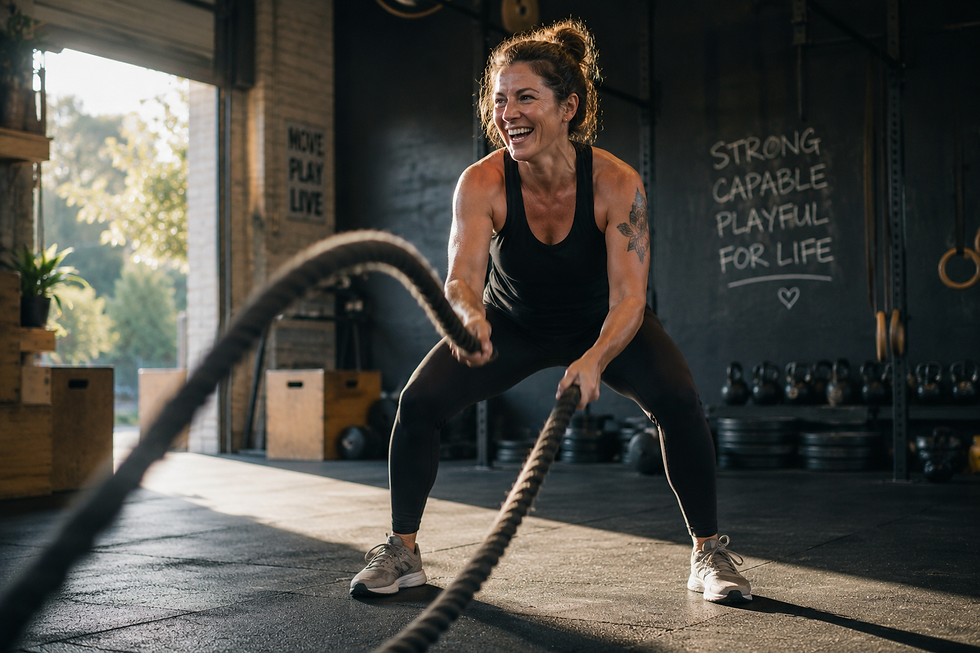
We work on this every single session at Breaking Barriers. Not by talking about it — by moving through it. Street Smart teaches you to stay present when every instinct says freeze or flee. Strength training teaches you that your body can handle more than your fear believes. Recovery work teaches you that rest is not weakness — it's the thing that makes the next effort possible. Each class is a controlled environment where you can meet the edge of your capacity and discover, repeatedly, that you don't fall off it.
That repetition builds something. Not just fitness. Evidence. A body of proof that you can handle hard things.
The Pattern I Know Best
I have had plenty of reasons to stop trying over the course of my life. All of them legitimate. All of them real.
But I have a stubbornness — probably an unhealthy amount, if I'm honest — that refuses to let me quit. Even when quitting would be the easier path. For a while, anyway.
I have fought hard for everything I have. Blood, sweat, and genuinely a lot of tears. And I am proud of that. Proud of the work ethic, proud of the independence, proud of what the hard work has built.
But here's the thing I'm learning, slowly and not without resistance: it's exhausting. It's lonely. And it is so much harder than it needs to be.
Not everything has to be a fight. I don't have to do everything the hard way for it to count — for it to be legitimate, earned, real. Maybe — and this is still a work in progress — maybe I can find a way to get to where I want to go without the struggle being the point.
This is where my own accountability comes in. Because I have some deep patterns to break. As we all do. And it is so much easier to stay in the pattern that feels familiar — that feels safe, that the nervous system recognises — than to choose differently.
My go-to pattern is disconnection. When things become overwhelming, I flick what I've come to call the humanity switch. Off go the emotions. Off goes the noise. And in that state I am, if I'm honest, incredibly productive. I get everything done. I keep moving. I function.
And it is one of my most unhealthy patterns.
Exercise has always been how I manage stress. Not gentle movement — combat sport, aerials, adrenaline-filled training that helps me feel something, or sometimes, punishes my body for the inconvenience of having emotions at all. I have always been self-aware enough to see this. What I am working on now — genuinely, actively working on — is implementing the changes that move me from awareness into something that actually looks different.
That gap — between knowing your pattern and living differently — is where the real work lives. We talked about this back in April. Awareness is a physical skill, not just a mindset. And the body has to be part of the change, not just the mind.
Accountability Is Yours — But Capacity Sets the Terms
Here's what I want to say clearly, because I think it's the piece that most often gets misunderstood.
Accountability is entirely within your control. How you respond to your patterns, the choices you make when you notice an old habit firing, whether you show up when it's hard — that's yours. No one else can carry it.
But accountability is not always within your current capacity. And those are two very different things.
When your system is overwhelmed — truly overwhelmed, not just uncomfortable — the question is not why aren't you pushing harder? The question is what do you need to increase your capacity so that the push becomes possible?
We explored this with a client last month. Chronic pain, genuine depletion, a schedule consuming more than it was giving back. The homework wasn't more effort. It was one honest question: what is one thing you can change this week to create more capacity?
That's accountability in its real form. Not self-punishment. Not pushing through an empty tank. But honest, clear-eyed assessment of what's actually happening — and one small, courageous choice in response.
In every Breaking Barriers class, we're practising this. The moment in a Street Smart drill when fear says I can't and you discover you can — that's accountability meeting capacity in real time. The session where you listen to your body and scale back instead of pushing through — that's the same skill, applied differently. You're learning to read the difference between discomfort that grows you and depletion that breaks you. That distinction, practised consistently, changes how you live.
Conditioned Response or Informed Choice?
This is the question I come back to constantly, in my own life and in my work with clients.
Are you responding from a conditioned pattern — one that your nervous system has run so many times it feels like truth? Or are you responding from a place of genuine awareness, with real information, making a deliberate choice?
Both can look identical from the outside. Both can even feel the same in the moment. The difference is whether you've paused long enough to ask the question.
Fear, in most of its forms, is a conditioned response. It learned something once and has been applying that lesson ever since — in relationships, in business decisions, in the way you hold back in a session when actually, your body is more capable than your history believes.
The antidote isn't courage in the motivational-poster sense. It's the slow, consistent, embodied practice of meeting the edge and staying present. Of noticing the fear, feeling it in the body — the breath that shortens, the shoulders that rise, the jaw that sets — and choosing, deliberately, what to do next.
Some days you push through the edge. Some days you rest at it. Both are valid. Both are part of building capacity. What matters is that the choice is yours — informed, honest, and made with full awareness of what you're working with.
What Changes When You Keep Showing Up
Here's what I have watched happen, in others and in myself, over years of this work.
The person who came in terrified of being hit — who flinched at every drill and apologised for taking up space — starts to stand differently. Not because someone told them to. Because their body has accumulated evidence that it can handle contact, can stay present under pressure, can recover and come back.
The person who trained purely to punish their emotions starts to notice, slowly, that movement can feel like something other than penance.
The person who disconnected from their body every time life got hard starts to find, in small moments, that staying present is survivable. That the feeling passes. That they are still standing on the other side of it.
This is embodied confidence. Not the loud kind. Not the performance. The quiet, settled knowing that you have handled hard things before — in here, on these mats, in your own body — and you can handle them again.
That's what Breaking Barriers is actually building. Not just a stronger body. A more honest, more responsive, more capable human being.
And that follows you home.
The Question Worth Sitting With
Are you in a conditioned response right now — in your training, in a relationship, in a decision you keep avoiding — or are you making an informed choice?
You don't have to answer it immediately. Just let it sit. Notice what comes up in the body when you ask it.
That noticing — that moment of honest inquiry — is where everything starts to shift.


Comments