


Becoming the Calm in the Room:

On Choice, Accountability, and Stopping Yourself From Giving Your Power Away
Can I ask you something honestly?
How many times this week have you caught yourself saying something like — why is the universe doing this to me? Or why can't I just have one moment of stability? Or some version of I just need a break — not from the work, but from the relentlessness of life itself?
I said something along those lines last week. Out loud. Possibly with some colourful language attached.
And I mean it when I say it in those moments. It genuinely feels like something outside of me is conspiring to keep things hard. And there is, if I'm honest, a strange comfort in that. Because if it's the universe — some great external force pulling the strings — then it can't be me. I can't be the reason things are chaotic. I'm just the one it's happening to.
Sound familiar?
The Comfort of Giving Your Power Away
We've been building something over these past months. Back in April we talked about awareness — not as a mindset tool, but as a physical skill. Something that lives in the body before it ever reaches the brain. In May we talked about structure as safety. In September we went deep on conditioned patterns — the responses your nervous system has rehearsed so many times they feel like fact.
This month sits right at the centre of all of it.
Because the thing about blaming the universe — or the timing, or the circumstances, or the people around us — is that it's not entirely wrong. Life does keep lifing. Things will always be happening. There will always be something to work through, overcome, celebrate, or grieve. That part is true and it's exhausting and some days it genuinely is too much.
But there's a version of that thinking that quietly slides into something else. Something that looks like wisdom but functions like surrender. When we hand our power over to an external force — even a benevolent one — we step out of the driver's seat. And once we're out of it, change becomes something that happens to us rather than something we participate in.
I want to be clear: I'm not talking about blame. Blame is not useful and it's not what I mean.
But accountability — honest, clear-eyed accountability — is the difference between surviving your life and actually living it.
The Twist That Trips Us Up
Here's where it gets complicated. And I'm speaking from personal experience here because this is genuinely something I'm still working through.
I have always been big on personal accountability. It's a value I hold deeply. But what I've come to realise — slowly, and sometimes the hard way — is that accountability, when it's sitting on top of an already overwhelmed nervous system, can twist into something else entirely. Into self-blame. Into why am I causing this? Into a kind of internal interrogation that is just as disempowering as blaming the universe, only it points the finger inward instead of outward.
Neither is the answer.
The honest truth — the one I keep coming back to in my own life and in the work I do with clients — is that much of what we do, much of how we respond, is learned behaviour.
Patterns buried so deeply in the nervous system that they don't feel like patterns. They feel like personality. Like just the way things are.
Last month I talked about my own go-to pattern — disconnection. Flicking the switch.
Getting everything done while quietly checking out of my own experience. I know it well. I can name it now in real time. And still, sometimes, I catch myself three days into that mode before I even noticed it started.
That's not failure. That's a nervous system doing exactly what it was conditioned to do: seek safety. Stay in what's known. Avoid the discomfort of something new.
Uncomfortable Is Where the Change Lives
And here is the most annoying part of all of this — I say that with full awareness that it's annoying — the change only happens in the uncomfortable places.
Not in the known. Not in the safe. Not in the pattern that feels familiar because you've lived it ten thousand times.
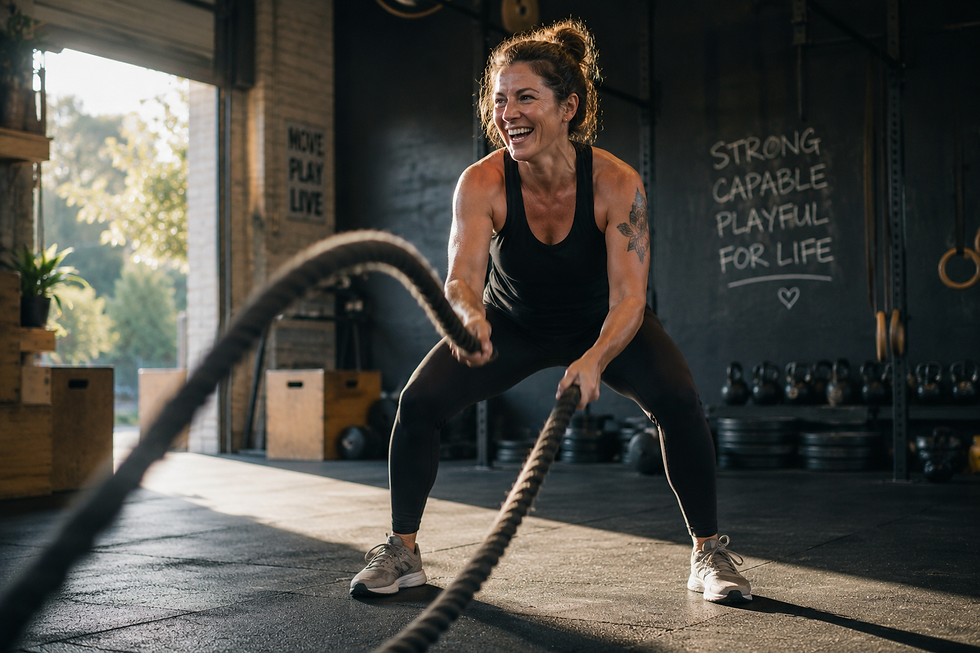
On the mats, we practise this constantly. Every time you step into a Street Smart drill that makes your heart rate spike before it's even started — that's discomfort. Every time you add weight to a lift that scares you a little — that's discomfort. Every time you stay present in a recovery session when every part of you wants to be doing something more — that's discomfort.
And every single time you stay in it — breathe through it, feel it, come out the other side — you are building evidence. Evidence that discomfort is survivable. That the edge doesn't mean falling. That you are more capable than the anxious part of your brain believes.
This is not a metaphor. This is how nervous system change actually works. Repeated exposure, with support, to the thing that triggers the old response — until a new response becomes possible. Not guaranteed. Not immediate. But possible.
And then, gradually, something shifts. Not because you white-knuckled your way through it. But because you gave your system enough evidence to update its file.
Choice Is the Thing That Remains
So where does that leave us?
Life will keep throwing things at you. The chaos is not going anywhere. The transitions, the unexpected turns, the moments where you genuinely cannot see how you're going to get through — those are part of being alive. Not punishment. Not a sign you're doing it wrong. Just life, doing what it does.
What you have — always, even when it doesn't feel like it — is choice. Not over what arrives. But over how you meet it.
Do you hand your power to an external force and wait to see what happens next? Or do you get curious about your own patterns — the ones driving the response before you've even consciously registered the situation?
Are you reacting from a conditioned response, or making an informed choice? We asked that question last month. It's worth asking again. And again. And probably for the rest of our lives.
I don't have this figured out. I want to say that clearly. I am not writing from a place of having arrived somewhere. I am writing from the middle of it — still learning, still catching myself mid-pattern, still occasionally blaming the universe on a hard week.
But I want more than survival. I want to thrive. And I've learned enough by now to know that thriving requires me to stay in the driver's seat — even when the road is rough, even when I'm tired, even when it would be so much easier to hand the wheel to someone or something else.
What This Looks Like in Class
Every session at Breaking Barriers is, in some way, a practice in choice.
The choice to show up when you don't feel like it. The choice to scale back when your ego wants to push through. The choice to stay present in the drill when your instinct is to check out. The choice to ask for help instead of quietly struggling through.
These are not small choices. They are, in many ways, the most important ones you make. Because the capacity you build for honest, accountable, self-aware choice-making in here? It doesn't stay in here.
It goes home with you. Into your relationships. Into your parenting. Into how you handle the next time life does what life does and the urge to blame something outside yourself rises up.
Notice it. Name it. And then — if you can — choose differently.
That's the work. It's not glamorous. It's not linear. But it is, without question, worth it.
The Question for This Month
Where in your life right now are you giving your power away — to the universe, to circumstances, to other people — and calling it wisdom?
You don't have to answer it out loud. Just let it sit. Notice what comes up in the body when you ask it.
That noticing — as always — is where it starts.


Comments